

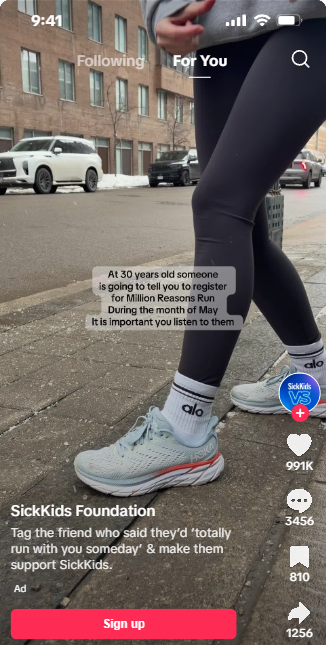
Strong nonprofit creative usually does five things well:
- Gives viewers an obvious reason to care or give.
- Shows the organization’s brand clearly.
- Introduces a clear call to action in the first 1 to 3 seconds.
- Uses human-centred imagery, often with direct eye contact.
- Works even if sound is off.
3. Collect Data That Makes the Next Ask Better
Ask yourself: Are we collecting data that improves the donor experience, or only data that fills a field?
Data powers media placements charities rely on, including remarketing, segmentation, Google Performance Max, Demand Gen, AI Max for Search, Meta Advantage+, and lookalike modelling. Clean, responsibly collected data helps these tools find stronger audiences, improve delivery, and reduce wasted media investment.
But data should do more than power platforms; it should help charities listen better. A petition signer, monthly donor, lapsed donor, event attendee, and newsletter reader each tell you something different. Those signals should shape the next message, ask, thank-you, and step in the donor journey.
Collect information that has a job to do, such as interests, motivations, communication preferences, event attendance, or past giving behaviour. Keep forms short, explain why you ask, and use each answer to improve the supporter experience. Then protect the value of that data by regularly removing duplicates, fixing errors, updating old records, and using consistent naming across platforms.
When charities use data this way, supporters feel remembered, not followed around. Better data also helps digital media platforms find higher-value audiences, reduce wasted media investment, strengthen stewardship, and build more relevant donor relationships.

4. Measure What Matters, Even When Attribution Gets Messy
Ask yourself: Can we connect digital activity to real gifts, or are we relying only on platform-reported results?
Attribution has never been perfect, and privacy changes have made it harder. That makes a clear measurement plan more important, not less. Fundraisers need to know which channels, audiences, creative, and conversion paths help drive real gifts, then use that evidence to decide where the next media dollar should go. Four steps help:
- Set up all tracking before launch, including analytics, UTMs, CRM integrations, and conversion APIs.
- Use platform data to optimize campaigns in market.
- Use CRM data as your source of truth to judge whether fundraising is cost-effective overall.
- Be realistic when calculating ROAS by removing donations that came from non-ad sources like a click from a newsletter.
The goal is not perfect attribution. The goal is enough clarity to make better decisions, defend media investment internally, and shift dollars toward the activity most likely to improve fundraising results.
5. Test Ideas Without Expecting Every Test to Win
Ask yourself: Are we testing to learn something useful, or are we only testing ideas we already expect to win?
Digital media improves when teams make room to test. If every test must deliver an immediate win, you limit what you can learn. A new audience, message, creative format, landing page, bid strategy, channel mix, or offer can deliver valuable insight on what donors notice, ignore, trust, or act on.
The best tests answer one specific question. Does a monthly giving ask outperform a one-time donation ask? Does a beneficiary story beat an urgent need message? Does a shorter landing page reduce friction? Does one channel introduce donors more efficiently while another converts them? Focused questions turn testing into learning instead of guesswork.
A useful test needs four things:
- Clear hypotheses.
- A willingness to learn from imperfect results.
- Separation between experimentation and core performance targets.
- Enough time and media investment to produce statistically significant data.
Testing works when it has room for learning. It helps teams learn faster, stop repeating weak ideas, and find the channels, messages, audiences, offers, and conversion paths worth scaling.
6. Let AI Help, But Keep People in Charge
Ask yourself: Are we using AI to improve speed, insight, and variation while still applying human judgment to strategy, tone, and donor trust?
AI can help fundraising teams move faster. It can create creative variations, summarize campaign performance, surface audience patterns, draft reporting notes, and generate landing page test ideas. At The Aber Group, we evaluate AI across media buying, creative iteration, analysis, and internal workflows. We use it to improve speed and learning while keeping people responsible for strategy, tone, ethics, and donor trust. AI works best when it strengthens human-led digital media strategy rather than replacing it.
The Bottom Line
The strongest digital fundraising programs usually do six things well: